
Recovery
Christian Porn Recovery: A Grace-First Guide to Actually Quitting

- Christian porn recovery is discipleship, not white-knuckling. You fight from a freedom Christ already gave you (Galatians 5:1), not for one you're trying to earn.
- At PrayBreak we organize a practical plan around three layers: walls, watchmen, and a weapon. Blockers reduce access, a trusted friend guards your honesty, and a practiced response is ready for the moment temptation is already happening. That's our framework, not a clinical protocol.
- Shame is not conviction. Conviction draws you toward God; shame drives you into hiding (Romans 8:1).
- Pornography use isn't always about sexual desire alone. Research on problematic pornography use has found associations with craving, stress, coping patterns, and loneliness, among other factors. Patterns differ from person to person.
- Start small and start now: guard one device, tell one person, and learn one practiced in-the-moment response. You don't need the perfect plan. You need the next honest step.
Christian porn recovery begins by refusing to earn a freedom you already have, and then building the structure to live in it: grace first, then walls, watchmen, and a weapon. Recovery isn't a single trick or a heroic burst of willpower. It's discipleship applied to one stubborn area, where you cooperate with God to retrain a habit, address what may sit underneath it, and stop fighting alone. This guide is the map. Each part below hands you off to a deeper one when you're ready to go further.
Start here, because everything else falls apart without it: "It is for freedom that Christ has set us free" (Galatians 5:1). You are not fighting to become accepted by God. If you're in Christ, you already are. You fight from that acceptance, not for it. Miss this and recovery becomes a performance review you can never pass. Get it, and every hard step below rests on solid ground.
What does Christian porn recovery actually mean?
It means addressing pornography as part of following Jesus, not just quitting a behavior. The goal isn't a clean streak for its own sake. It's freedom, intimacy, and integrity that last, with God involved in the retraining rather than watching from the sidelines while you try to earn your way back.
Secular recovery aims at a number: days clean, urges resisted, discipline gained. Those are good, but they're not the point for a Christian. The point is a person. Porn is not only a habit to break. It is a counterfeit of something real, like intimacy, comfort, rest, and being known, which it can never actually deliver. Christian recovery goes after the counterfeit and also points you to the real thing.
That reframe changes how you fight. If the goal were only abstinence, the strongest willpower would win. But Scripture is honest that trying harder doesn't break chains. Freedom is something you receive and practice, not something you grit into existence. This is also why guilt and grace produce very different recoveries, and why one of them quietly fails.
Why is porn so difficult to quit on your own?
Because several factors usually interact at once. Research on problematic pornography use has identified craving, stress, coping patterns, loneliness, frequent use, and low self-esteem among associated factors, and easy private access sits on top of all of it. A plan that changes only one of those tends to leave the others untouched.
Most people try the same strategy for years: promise harder, fail, feel awful, repeat. It isn't a character flaw that this doesn't work well. Research has found that problematic pornography use is associated with a range of interacting factors rather than a single cause. A systematic review of 66 studies sorted them into biological, psychological, and social categories, with craving, stress, coping styles, frequent use, low self-esteem, and loneliness among those repeatedly identified. Those are associations rather than proven causes, and the mix differs from person to person.
That matters practically, because it means there is probably no single lever. Reducing easy access, having people who know the truth, and having something specific to do when temptation is already happening each address a different part of the picture. None of them is a guarantee, and you may need more than one. We break down the in-the-moment part in the battle plan.
One caution worth stating plainly: pornography use is not always driven by sexual desire alone, but it is also not true that everyone must excavate a hidden emotional root before change is possible. Some people are carrying real pain that porn learned to numb. Others are mostly carrying a well-worn habit and a phone. Both are worth taking seriously, and neither description is universal.
And there is the spiritual dimension, the oldest one: this was never meant to be fought alone. "Confess your sins to each other and pray for each other so that you may be healed" (James 5:16). Scripture treats secrecy as a spiritual problem, not merely a tactical one, and it treats confession as the ordinary road back rather than a last resort.
Is porn addiction a real diagnosis?
"Porn addiction" is not itself a formal ICD-11 diagnosis. The ICD-11 recognizes Compulsive Sexual Behaviour Disorder, which can involve problematic pornography use for some people. Diagnosis requires persistent impaired control plus significant distress or impairment, and distress based entirely on moral disapproval is not sufficient on its own.
This distinction gets flattened constantly, in both directions, and both errors do damage. Telling someone with genuine impaired control that they are "just feeling guilty" is dismissive. Telling someone whose distress is mainly a values conflict that they have a brain disease is frightening and probably inaccurate. The honest position is that these are different things which can also overlap in the same person.
The ICD-11 classifies Compulsive Sexual Behaviour Disorder under impulse-control disorders rather than under disorders due to addictive behaviours, and its guidance is explicit that distress arising entirely from moral judgments and disapproval about sexual impulses or behaviour is not enough by itself to meet the diagnostic threshold. That is a meaningful safeguard, and it is worth knowing before you apply any label to yourself. What the research actually says about feeling addicted versus being addicted goes deeper.
How is Christian recovery different from NoFap or secular quitting?
The motive differs. Secular quitting is usually self-improvement: focus, confidence, discipline. Christian recovery is about who you belong to. It also takes seriously something research describes, that using pornography against deeply held convictions creates genuine moral conflict, without reducing every Christian's struggle to that conflict alone.
For Christians, pornography may create real moral conflict because the behaviour violates convictions you actually hold. Researchers call this moral incongruence, and it can contribute to pornography-related distress and to a person's sense of being addicted. That is a genuine finding and it deserves to be taken seriously rather than waved off as mere guilt.
But moral conflict is not the whole picture, and this is where a lot of Christian writing overreaches. In a study of 66,994 people across 42 countries, researchers identified six distinct pornography-use profiles, including two increased-risk groups: one with problematic use and some moral disapproval, and one with problematic use and no moral disapproval. Behavioural dysregulation can exist with or without a values conflict. A separate analysis of the same international sample found that pornography-use frequency had moderate-to-strong associations with problematic use and self-perceived addiction, while religiosity's associations were weak and positive, with moral incongruence acting as a moderator that strengthened the frequency link rather than replacing it.
What this does mean is that secular fixes have a ceiling for a Christian. Chasing better focus or a longer streak never touches the part of this that is about who you belong to. We unpack the evidence carefully, including where it's contested, in what the research says about feeling addicted.
What are walls, watchmen, and a weapon?
At PrayBreak we organize a practical recovery plan around three layers. Walls are blockers and device settings that reduce easy access. Watchmen are the people who know your fight and ask hard questions. The weapon is your practiced response for the moment temptation is already happening. This is our framework, not a clinical protocol.
We borrow the imagery from Nehemiah 4: rebuilding defenses, posting watchmen, and staying ready for opposition. "Those who carried materials did their work with one hand and held a weapon in the other" (Nehemiah 4:17). Defense, community, and readiness, all at once. That is a metaphor we find useful, not a claim that Nehemiah was teaching a pornography-recovery method.
| Layer | What it is | What it can't do |
|---|---|---|
| Walls | Blockers, filters, and device settings that reduce easy access | Stop a determined urge that routes around them, or calm the storm inside |
| Watchmen | One or more people who know the truth and check on you | Be present in the exact moment you're alone with a phone |
| Weapon | A practiced response you run when temptation is already happening | Undo an unguarded device or years of hidden struggle by itself |
These layers address different needs, so some people find a combination useful. All walls and no watchmen is a fortress with no one inside. All accountability and no in-the-moment plan means your accountability partner hears about it the next morning. If you want to see how blocking tools and in-the-moment tools actually differ, here's the full breakdown.
On the watchmen layer specifically, the research is encouraging but modest, and we would rather tell you that than oversell it. Two studies in Poland, one of them on a nationally representative sample of 1,526 adults, found perceived social support was a weak protective factor against compulsive sexual behaviour and problematic pornography use. Weak, not decisive. Separately, a qualitative study of 27 people in structured recovery found participants themselves described accountability as a central mechanism of change, linked to honesty and relapse prevention. That's how those people experienced it, which is worth something, and it is not proof that accountability works the same way for everyone.
What handles the urge that gets through?
The weapon layer: a practiced response you run when temptation is already happening, because some urges will get through any wall. Most plans skip this entirely. Blocking tools primarily reduce access and accountability primarily provides visibility and support, so the live moment often has nothing assigned to it at all.
Blocking tools primarily reduce access. Accountability approaches primarily provide visibility and human support. Devotionals build you up over weeks. PrayBreak focuses specifically on giving you a structured Christian response when temptation is already happening. It helps to know what you're facing: how long a porn urge actually lasts is more honest than most articles about what research has and hasn't established, and how to stop porn urges at night covers the hardest version of the moment.
PrayBreak's response starts with a press and hold, then follows a short Ritual: HOLD, LOOK, PRAY, MOVE. The Ritual intentionally combines attention redirection, guided prayer, and physical action in a short sequence. We designed it that way because those are three things a person can actually do while under pressure, not because we have clinical evidence testing this specific app. We walk through it in the battle plan. Practice it before you need it, the way you'd practice a fire drill.
What role do prayer and Scripture play in recovery?
For Christians, prayer turns the moment toward God rather than deeper into fantasy, and invites His help while temptation is happening rather than only afterward. Scripture reshapes what you believe about God and yourself, including the lie that you are beyond help. We recommend both on theological grounds, not as tested clinical techniques.
Most people pray about porn only after they've fallen, when prayer feels like an apology. Scripture invites the opposite: approach God "with confidence, so that we may receive mercy and find grace to help us in our time of need" (Hebrews 4:16). The time of need is during the temptation, not the morning after. That is the whole argument for praying mid-battle, and it is a theological argument rather than a claim about measured effects on craving.
The practical problem is that in the moment, most people don't have words. That's why it helps to have a few short, honest prayers ready before temptation arrives. Not polished, just real. We collected ten battlefield prayers worth memorizing, each tied to the Scripture behind it, for exactly the moment when your mind goes blank. For the longer fight there is a prayer against porn addiction, and the Scripture on lust, grouped by the moment you need it, is in these Bible verses about lust.
Scripture also gives the response a shape. "Flee from sexual immorality" (1 Corinthians 6:18) is not subtle, and Paul tells Timothy to flee the evil desires of youth and pursue righteousness, faith, love and peace alongside other believers. Notice that both verses pair leaving something with moving toward something. That is the instinct behind the MOVE step, and it is why we don't ask you to stand still and prove your strength.
What should I do after a relapse?
Respond quickly rather than turning one lapse into permission to continue. Confess honestly, take one practical action, and reconnect with someone who knows. Separate shame from conviction: conviction says 'you did wrong, come home' and moves you toward God, while shame says 'you are wrong, stay hidden' and moves you away.
One lapse does not require another. The most common way a single fall becomes a long stretch is the story told about it afterward: I've already blown it, so what's the point. Broader relapse research describes this pattern as the abstinence violation effect, a concept developed in the wider addiction literature rather than in pornography-specific research. We mention it because the shape is recognisable, not because it has been measured for porn.
So do the opposite of what shame demands. "If we confess our sins, he is faithful and just and will forgive us our sins and purify us from all unrighteousness" (1 John 1:9). Pray before you feel clean. Tell someone soon rather than after a good week. Shortening the gap between the fall and getting up is the practical goal, and it is worth pursuing whether or not you can feel it working yet.
Hold both halves of this. Romans 8:1 means there is no condemnation waiting for you in Christ. It does not mean the behaviour didn't matter. Grace without minimizing sin, conviction without hopeless condemnation. Christians who lose either half tend to end up either brittle or stuck.
One pattern worth naming honestly: if your sessions have been stretching from minutes into hours, or escalating toward more extreme material, that's not simply "more of the same." It's a distinct pattern with its own anatomy and its own exit. Here's what gooning is and how to break it.
“Therefore, there is now no condemnation for those who are in Christ Jesus,”
Does treatment for problematic pornography use actually work?
The evidence is promising and still limited. A 2025 meta-analysis of 20 studies with 2,021 participants found people receiving psychotherapy, mostly CBT and ACT, improved more than controls on problematic use, frequency, and sexual compulsivity. The same authors cautioned that the research base carries a high risk of bias.
This is worth knowing precisely because so much Christian writing about porn skips it entirely and leaves readers assuming there is nothing but willpower and prayer. There is more than that. A 2025 meta-analysis pooling 20 studies and 2,021 participants found that psychotherapy, most often cognitive behavioural therapy and acceptance and commitment therapy, produced significantly greater improvement than control conditions in problematic pornography use, in frequency and duration of use, and in sexual compulsivity, with smaller effects on craving. The authors were direct about the limitations: methodological problems and a high risk of bias across the included studies, with a call for more rigorous randomized trials.
A 2026 scoping review of CBT-based protocols reached a compatible conclusion from another angle. Across 11 studies published between 2019 and 2024, all reported reductions in frequency and symptoms, but the review found no widely accepted, standardized, evidence-based treatment protocol for problematic pornography use, along with high dropout in self-guided interventions. So: real help exists and is worth seeking, and nobody has a finished, validated recipe yet.
That cuts against overclaiming in every direction, ours included. PrayBreak is an in-the-moment Christian tool. It has not been clinically tested, it is not a treatment for Compulsive Sexual Behaviour Disorder, and it is not a substitute for therapy for anyone who needs it.
When should I consider professional help?
If pornography or sexual behaviour feels persistently out of control, is interfering with your relationships, work, school, or daily functioning, or keeps causing significant distress despite repeated attempts to change, it's worth talking with a qualified mental-health professional familiar with problematic pornography use or compulsive sexual behaviour.
Needing professional help is not evidence of weak faith, and no part of this guide should be read that way. Christians see doctors for broken bones without treating it as a spiritual verdict, and this is not different. You can reasonably look for someone who respects your faith and your values, and it is fair to ask a prospective counselor about that directly in a first conversation.
If your struggle also involves depression, anxiety, or thoughts of self-harm, please make that the priority and talk to a licensed professional. In the U.S. you can call or text 988, the Suicide and Crisis Lifeline, at any time.
Where do I actually start this week?
Pick one move from each layer and do it in the next 48 hours. Guard one device, tell one person, and learn one practiced in-the-moment response. Don't wait for the perfect plan or the motivated Monday. Recovery is built from the next honest step, repeated, not from a grand restart you keep postponing.
Build one wall today
Charge your phone outside the bedroom tonight, or install a blocker on the device where you actually fall. One real wall beats a perfect plan you never set up. If you're choosing tools, here's an honest comparison of the current apps and what each layer is for.
Recruit one watchman this week
Tell one trustworthy person the truth, not a vague 'I struggle,' but the actual pattern. Ask them to check in and to ask hard questions. Scripture treats confession as the ordinary road back rather than a last resort (James 5:16), and people in structured recovery often describe accountability as one of the things that mattered most to them.
Practice one weapon before you need it
Learn the press-and-hold, then the HOLD–LOOK–PRAY–MOVE response, and rehearse it once while calm so it's familiar when temptation is live. Memorize one battlefield prayer. When the moment comes, you won't rise to your intentions. You'll fall to your practice.
Preach grace to yourself daily
Every morning, before you've earned anything, remind yourself there is no condemnation in Christ (Romans 8:1). You are fighting as a loved child, not an accused defendant. The people who last are the ones who fight rested in grace, not braced against rejection.
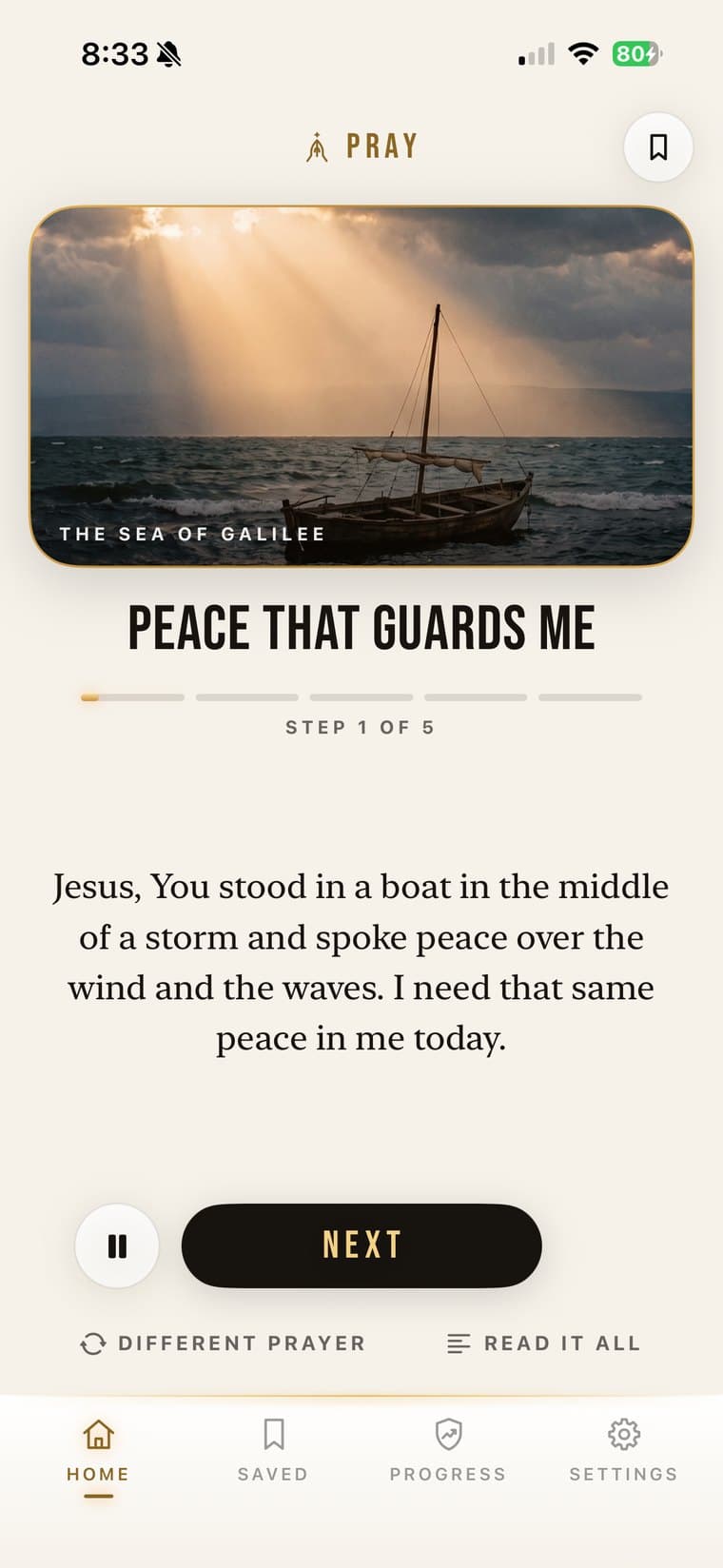
None of these four require you to feel strong, motivated, or 'ready.' They require one honest decision each. That's the whole method: not a heroic transformation on day one, but a child of God taking the next real step, then the next, guarded by walls, known by watchmen, armed with a weapon. When temptation comes, here's exactly what to do.
Frequently Asked Questions
Can a Christian actually be free from porn, or just manage it?
Galatians 5:1 says Christ set us free, and Christians have historically understood that as real freedom rather than permanent management. In practice that rarely means urges vanish overnight. It usually means the habit loses its grip as access, honesty, and a practiced response replace secrecy and solo willpower.
How long does Christian porn recovery take?
There is no reliable universal timeline. People differ in the severity and pattern of their use, their support, their goals, the factors underneath it, and whether they get treatment. Recovery is better measured as a direction you keep walking than as a countdown to a finish line.
Do I need a blocker, an accountability partner, or an app?
They address different needs, so some people find a combination useful. A blocker reduces easy access, a person guards your honesty, and a practiced response handles the live moment. Start with whichever you're most obviously missing rather than trying to build all three at once.
Is porn addiction a real diagnosis I should be worried about?
"Porn addiction" is not itself a formal ICD-11 diagnosis. The ICD-11 recognizes Compulsive Sexual Behaviour Disorder, which can involve problematic pornography use for some people. It requires persistent impaired control plus real distress or impairment, and distress based entirely on moral disapproval isn't sufficient on its own.
I keep relapsing. Does that mean recovery isn't working?
Not necessarily. One lapse does not require another. Confess honestly (1 John 1:9), take one practical step, tell your watchman soon, and keep walking. The danger is usually the story you tell yourself afterward, which is what turns a single fall into a longer stretch.
How do I start if I feel too ashamed to even pray?
Pray anyway, before you feel clean. The idea that you must tidy yourself up before approaching God is exactly the shame that keeps the cycle turning. Hebrews 4:16 invites you to come for grace in your time of need, mid-mess. Say one honest sentence now, then tell one trusted person.
- López-Pinar, Esparza-Reig & Bőthe — Psychotherapy for problematic pornography use: A comprehensive meta-analysis (Journal of Behavioral Addictions, 2025; 20 studies, 2,021 participants). Authors note a high risk of bias across included studies.
- Zwielewski et al. — Cognitive behavioral therapy-based interventions for problematic pornography use: a scoping review (Sexual Medicine Reviews, 2026; 11 studies, 2019–2024). Finds no widely accepted standardized treatment protocol.
- Seyedzadeh Dalooyi et al. — Biopsychosocial Determinants of Problematic Pornography Use: A Systematic Review (Addiction & Health, 2023; 66 studies). Factors associated with problematic use, not established causes.
- Wizła, Glica, Gola & Lewczuk — The relation of perceived social support to compulsive sexual behavior (Journal of Psychiatric Research, 2022; two studies, n=807 and n=1,526). Social support was a weak protective factor.
- Lorente-Corral et al. — Identity Transformation and the Role of Accountability in Recovery from Problematic Pornography Use (Journal of Clinical Medicine, 2026; qualitative, 27 people in structured recovery). Describes participants' own experience, not generalizable outcomes.
- Bőthe et al. — Moral disapproval and behavioral dysregulation-based pornography-use profiles across 42 countries (Journal of Behavioral Addictions, 2025; N=66,994). Six profiles, including increased-risk groups with and without moral disapproval.
- Bőthe et al. — A global investigation of the Moral Incongruence Model of Pornography Use across genders, religions, and cultures (Journal of Behavioral Addictions, 2026; N=66,994, 34 countries).
- Grubbs, Perry & Wilt — Pornography Problems Due to Moral Incongruence: An Integrative Model with a Systematic Review and Meta-Analysis (Archives of Sexual Behavior, 2019).
- World Health Organization — ICD-11: Compulsive sexual behaviour disorder
Scripture quotations taken from The Holy Bible, New International Version® NIV®. Copyright © 1973, 1978, 1984, 2011 by Biblica, Inc.™ Used by permission. All rights reserved worldwide.
PrayBreak is built for the moment that decides everything — press and hold, then LOOK, PRAY, MOVE. This time, have a weapon in your hand.