
In the Moment
How to Stop a Porn Urge Right Now: The 4-Step Battle Plan

- Stop escalating first. Put the device down and stop scrolling before you try to win an argument in your head.
- At PrayBreak we use a four-step response when temptation is already happening: HOLD, LOOK, PRAY, MOVE. That's our framework for the moment, designed to give you something specific to do rather than something to resist.
- Put physical distance between yourself and the trigger. Scripture repeatedly uses the language of fleeing sexual temptation rather than lingering with it (1 Corinthians 6:18; 2 Timothy 2:22).
- Bring the temptation to God rather than continuing to turn it over in your mind. Hebrews 4:16 invites Christians to approach God for grace in the time of need, and the time of need is now.
- If you fall, confess honestly, reconnect with someone you trust, and return to the fight rather than treating one lapse as permission to continue.
To stop a porn urge right now: put the device down, get out of the room, pray honestly, and run a practiced response instead of an argument. At PrayBreak that response is four steps, HOLD, LOOK, PRAY, MOVE, and this article walks through each one. You don't have to defeat lust permanently in this moment. You have to decide what happens in the next few minutes.
"God is faithful; he will not let you be tempted beyond what you can bear. But when you are tempted, he will also provide a way out" (1 Corinthians 10:13). That verse doesn't hand you a timetable for how long an urge lasts. It gives Christians a reason not to treat temptation as inevitable defeat, which is a different and better thing.
What is actually happening when a porn urge hits?
Research on problematic pornography use suggests that sexual cues, craving, attention, and inhibitory control all play a role in moments of impaired control. For some people, pornography-related cues become highly salient and hard to disengage from. That is a real difficulty, not a character verdict.
It helps to know what researchers have actually found, because the popular version of this ("porn hijacks your brain") is both frightening and vaguer than the evidence. A systematic review of 21 experimental studies on the cognitive processes involved in problematic pornography use examined attentional bias toward sexual stimuli, inhibitory control, working memory, and decision-making. The authors were clear that the experimental evidence base is still limited, so treat these as directions the research points rather than settled facts about every person.
Two findings are worth having in mind tonight. In an fMRI study comparing 28 men seeking treatment for problematic pornography use with 24 men without it, the difference appeared in responses to cues predicting erotic images rather than to the images themselves. And in a study combining laboratory tasks with a week of real-world reporting across 118 participants, 44 of them in a pornography group, greater average craving was associated with more frequent moments of impaired control, while reduced behaviour-specific inhibitory control tracked those moments in daily life. Those findings generalized across the pornography and gaming groups, so it isn't a pornography-only result.
The practical translation: the cue and the craving are doing real work, and the moment you notice them is the moment worth acting on. Thinking of an urge as a wave can be useful, because its intensity can change rather than climbing forever. But research does not give us a reliable stopwatch for how long a pornography urge will last, and anyone who quotes you a number is extrapolating. Here's what is and isn't established about that.
What are the 4 steps to stop a porn urge?
At PrayBreak we use a four-step response when temptation is already happening: HOLD, LOOK, PRAY, MOVE. HOLD creates an intentional pause and starts the Ritual. LOOK pulls your eyes off the fantasy. PRAY brings the moment to God. MOVE gets you physically out of the trigger. This is our framework, not a clinically tested protocol.
We designed the sequence deliberately: pause, notice, turn toward God, then act. Each step exists because it gives you something specific to do at a moment when "just don't" is famously hard to execute. What follows is what the app actually does, step by step.
HOLD — create the pause
Open PrayBreak and press and hold the Break button for three seconds while it counts down 3-2-1, with the vibration running the whole time. Completing the hold is what carries you into the rest of the Ritual. It is designed to interrupt whatever you were about to do and put a deliberate next step in its place. That's a product-design decision, not a claim about your neurology.
LOOK — get your eyes off the fantasy
The app opens one of seven guided exercises. Cross Focus, for example, holds your attention on a cross with Psalm 46:10, "Be still, and know that I am God," and asks you to breathe slowly; "Different exercise" swaps it for another if that one isn't landing tonight. The point of the step is to notice what is happening rather than automatically act on it, and to give your eyes somewhere else to be.
PRAY — bring it to God
PrayBreak leads you through a written prayer in five short steps, so you don't have to compose anything mid-temptation. For a Christian, prayer brings the temptation directly before God instead of leaving fantasy and negotiation as the only voices in the moment. Scripture invites you to approach the throne of grace "so that we may receive mercy and find grace to help us in our time of need" (Hebrews 4:16), and this is a time of need. We keep ten battlefield prayers worth memorizing here.
MOVE — leave, physically
The last step is a guided physical reset, one of eighteen short exercises, from To the Hills (thirty seconds of knee drives) to Cold Reset, which sends you to the sink for cold water on your face. Sometimes the wisest next move is simply literal. Leave the room, put down the phone, step outside, remove access to whatever is pulling at you. When Joseph was cornered by Potiphar's wife, he "left his cloak in her hand and ran out of the house" (Genesis 39:12).
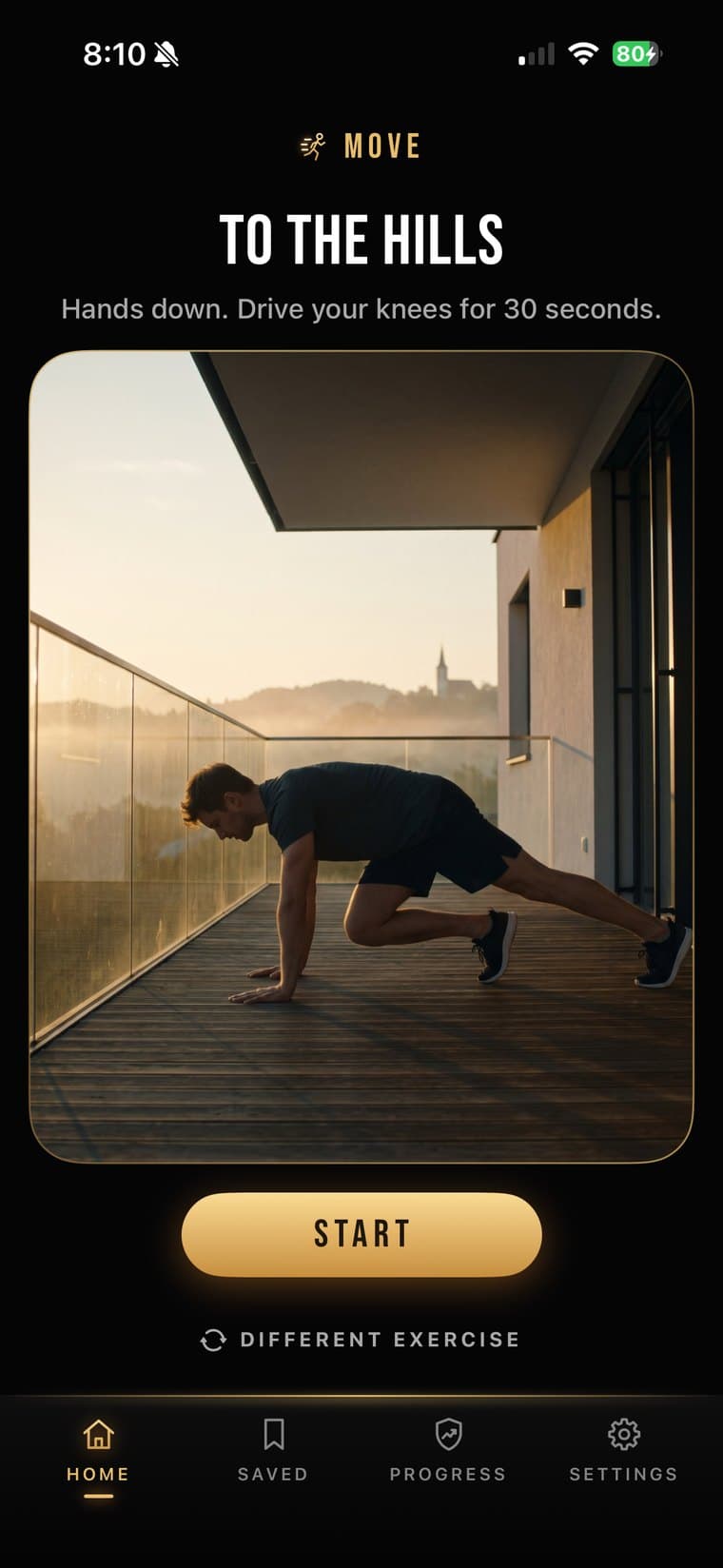
Scripture repeatedly uses the language of fleeing sexual temptation rather than lingering with it. "Flee from sexual immorality" (1 Corinthians 6:18), and Paul tells Timothy to flee the evil desires of youth and pursue righteousness, faith, love and peace alongside other believers. Both verses pair leaving something with moving toward something, which is the instinct MOVE was built on.
Why might willpower alone not be enough?
Because "don't do it" asks you to hold a line at the moment craving is strongest. Pornography-specific research has linked craving intensity and reduced inhibitory control with moments of impaired control in daily life. Having a specific action to take can be easier to execute than an internal argument.
Most people know the 11pm argument: I shouldn't. But I want to. But I promised. But just once more. There is a reason that argument is hard to win, and it isn't that you lack character. Continuing to elaborate on the desire may intensify craving for some people. In a study of 191 people screened for problematic internet pornography use, desire thinking was related to the escalation of craving, alongside metacognitive beliefs and negative affect. That's a path model built on cross-sectional data rather than an experiment, so read it as a relationship rather than a proven mechanism. It still points somewhere practical: the debate itself keeps the fantasy in front of you.
So the useful move is usually to stop negotiating and do something instead. Not because willpower always loses, but because a practiced action is easier to run under pressure than a fresh act of resolve.
There is also a spiritual frame worth holding. "It is for freedom that Christ has set us free" (Galatians 5:1). You fight from acceptance rather than for it. That doesn't guarantee a particular outcome on a particular night, and Scripture doesn't promise that trying harder is what breaks chains. If what's actually defeating you is a belief that you're permanently broken, what the research says about feeling addicted versus being addicted is better news than you've probably been told.
What if the urge keeps coming back?
Craving can fluctuate or return. If temptation comes back, respond again rather than treating its return as failure. If urges are frequent or persistently hard to manage, it's worth looking at access, recurring cues, support, and broader emotional patterns rather than only fighting harder in the moment.
First, tonight. One wave often isn't the whole evening. You may respond, settle, and feel it rise again an hour later. You don't need to work out whether that's technically the same craving or a new one. Respond again. A night with two or three interrupted moments is a night you responded two or three times.
Second, the strategic answer. If you're running this every single night, the setup deserves attention as much as the moment does. The full plan of walls, watchmen, and a weapon is laid out in the complete Christian porn recovery guide. Some changes worth considering:
- Change the phone-in-bed pattern. For a lot of people the fight happens in bed, alone, with a phone in reach. Charging it outside the bedroom removes one of the easiest access points. The full nighttime playbook is here.
- Tell one person. Christian confession isn't a last resort; it's the ordinary road back. "Confess your sins to each other and pray for each other so that you may be healed" (James 5:16). Being known changes what you carry alone, whatever else it does.
- Remove easy access. Jesus uses striking language in Matthew 5:29 about removing what repeatedly leads someone toward sin. The practical principle is clear enough: you don't have to preserve easy access to something that keeps pulling you toward wrongdoing. Delete the app, block the site, close the account, move the phone.
- Look at the pattern outside the moment. For some people, recurring pornography use is connected with loneliness, stress, or difficulty regulating emotion. Research on problematic pornography use has found emotion-regulation difficulties associated with it, with loneliness as a partial mediator in a sample of 339 people. That's correlational and it won't describe everyone. But if the same pattern keeps showing up around your use, it's worth addressing in daylight as well as at 11pm.
One more pattern worth naming: if your sessions have been stretching from minutes into hours, that's not just "more of the same problem." It's a different pattern with its own anatomy. Here's what gooning is and how to break it.
And if pornography use feels persistently out of control, is interfering with your relationships or daily functioning, or keeps causing real distress despite repeated attempts to change, it's worth talking to a qualified mental-health professional. A 2025 meta-analysis of 20 studies and 2,021 participants found psychotherapy, most often CBT and ACT, produced greater improvement than control conditions, while the authors also flagged methodological limitations and a high risk of bias in the evidence base. Seeking help is not a verdict on your faith.
What should I do after a relapse?
Respond rather than disappearing. Confess honestly to God (1 John 1:9), step away from whatever was feeding the behaviour, and reconnect with someone you trust. One lapse does not require another. In Christ there is no condemnation (Romans 8:1), and the story you tell yourself afterward matters more than the clock.
The most common way a single fall becomes a longer stretch is the story told about it afterward: I've already blown it, so what's the point. Broader relapse literature calls that the abstinence violation effect, a concept developed outside pornography research. We mention it because the shape is recognisable, not because it has been measured for porn specifically.
Shame says: hide, don't pray until you've cleaned up. Do the opposite. "If we confess our sins, he is faithful and just and will forgive us our sins and purify us from all unrighteousness" (1 John 1:9). Pray before you feel clean. Tell someone soon rather than after a good week. Then sleep.
Hold both halves of this. Romans 8:1 means no condemnation is waiting for you in Christ. It does not mean the behaviour didn't matter. Conviction without hopeless condemnation is the balance, and Christians who lose either half tend to end up either brittle or stuck. Tomorrow you are not starting over. You are continuing something God is at work in (Philippians 1:6), which is a promise about His faithfulness rather than a guarantee about any particular habit's timeline.
“Therefore, there is now no condemnation for those who are in Christ Jesus,”
What tools actually help in the moment of temptation?
Most tools are built primarily for calm moments: blockers reduce access, trackers count streaks, devotionals build habits over weeks. PrayBreak is specifically designed around a guided Christian response for when temptation is already happening: HOLD (a three-second press on the Break button), then LOOK, PRAY, MOVE.
| Tool type | What it primarily does | When it typically helps | The limit |
|---|---|---|---|
| Porn blockers / filters | Reduce access to sites and apps | Before temptation, by removing easy doors | A determined urge can often route around them, and they don't address what's happening inside |
| Accountability apps | Give a trusted ally visibility | Over weeks, by building honesty and support | Reports often arrive after tonight's moment has passed |
| Streak trackers | Count days and mark milestones | Motivation between hard moments | A number is hard to lean on at the peak, and a broken streak can feed a shame spiral |
| Devotionals / content apps | Daily Scripture, courses, community | Formation over time | Typically not designed to be opened mid-temptation |
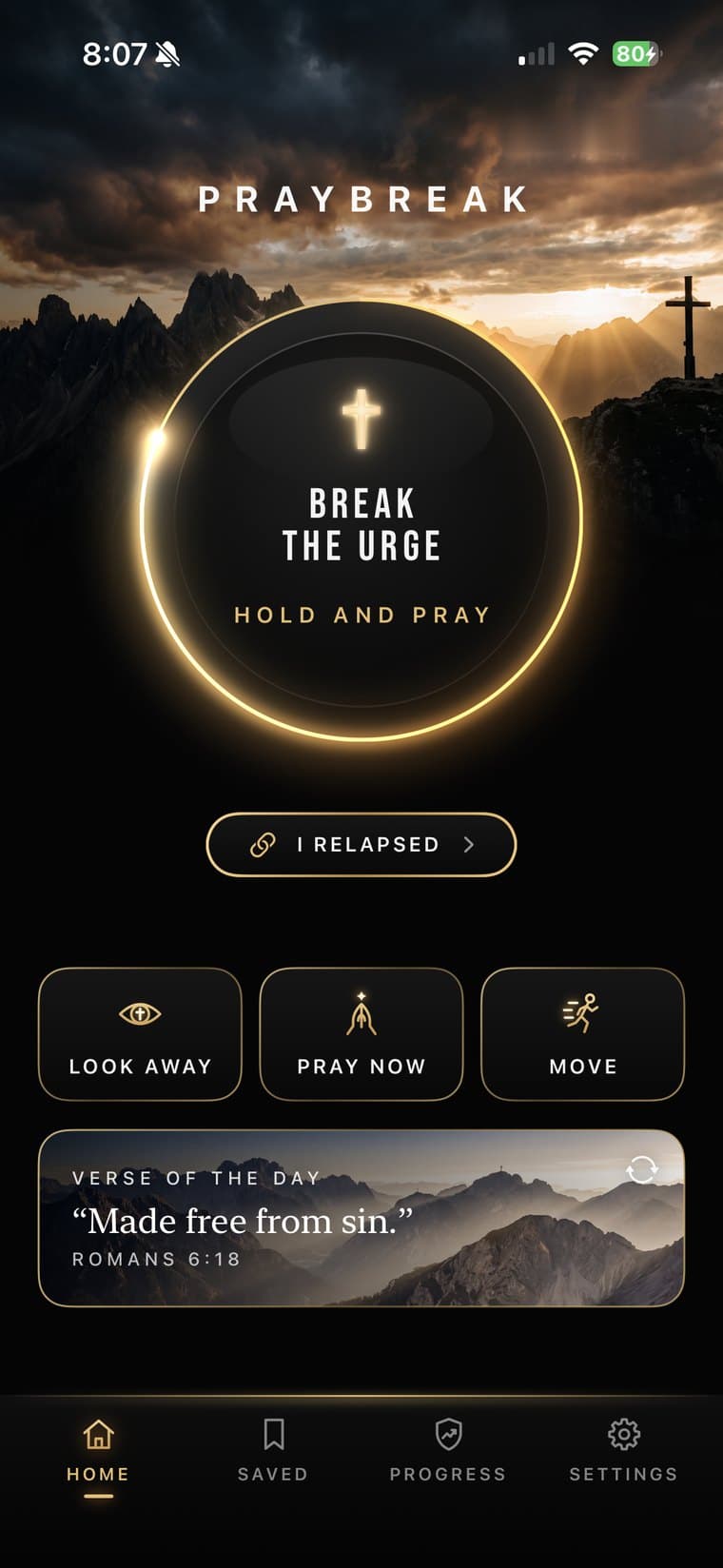
The right setup is usually a stack rather than a single app: a blocker to reduce easy access, one person who knows the truth, and a practiced response for the moments that get through. That last layer is the one PrayBreak was built for. Whatever tools you choose (here's our full comparison of the current apps), the live moment is worth having a plan for, because it's the moment you're actually in when it counts.
Frequently Asked Questions
How long does a porn urge actually last?
Research has not established a universal duration for pornography urges. Craving can fluctuate and change over time, but there is no reliable pornography-specific countdown, and the numbers quoted online come from general craving material. Here's what is and isn't established.
Is feeling tempted the same as sinning?
Temptation appearing is not the same as choosing to cultivate or act on it. Hebrews 4:15 distinguishes temptation from sin, while Matthew 5:28 and James 1:14–15 remind Christians not to deliberately nurture lust. The arrival of the temptation is the fight starting, not the fight lost.
What's the fastest way to stop a porn urge at night in bed?
There's no scientifically established fastest technique. A practical first move is to get out of the triggering environment: stand up, leave the bed, then run your practiced response. The full nighttime playbook is here.
Does praying actually help against urges, or is that wishful thinking?
Prayer is central to a Christian response to temptation because Scripture invites believers to bring their need directly to God. Hebrews 4:16 calls Christians to approach the throne of grace for help in a time of need. We recommend it on that basis, not as a tested clinical technique.
I keep failing even with a blocker installed. What am I missing?
A blocker addresses access. Some people also benefit from trusted human support and from having a specific response ready for when temptation is already happening. That last part is what PrayBreak's HOLD, LOOK, PRAY, MOVE is built for.
What should I do right after a relapse?
Respond rather than disappearing. Confess to God (1 John 1:9) without waiting to feel clean, step away from whatever was feeding it, and tell someone you trust soon. One lapse does not require another, and the story you tell yourself matters more than the clock.
- Castro-Calvo, Cervigón-Carrasco, Ballester-Arnal & Giménez-García — Cognitive processes related to problematic pornography use (PPU): A systematic review of experimental studies (Addictive Behaviors Reports, 2021; 21 experimental studies). Authors note the experimental evidence base is still limited.
- Allen, Kannis-Dymand & Katsikitis — Problematic internet pornography use: The role of craving, desire thinking, and metacognition (Addictive Behaviors, 2017; N=191, cross-sectional path analysis). Associational.
- Gola et al. — Can Pornography be Addictive? An fMRI Study of Men Seeking Treatment for Problematic Pornography Use (Neuropsychopharmacology, 2017; 28 treatment-seeking men vs 24 controls). Cue reactivity.
- Knorr, Wegmann, Vollbracht, Brand & Antons — Predicting moments of impaired control over addictive behaviors (Journal of Behavioral Addictions, 2026; N=118, of whom 44 pornography and 74 gaming; lab tasks plus 7-day EMA). Findings generalized across both behaviour groups.
- Cardoso, Ramos, Brito & Almeida — Difficulties in Emotion Regulation and Problematic Pornography Use: The Mediating Role of Loneliness (International Journal of Sexual Health, 2023; N=339, cross-sectional self-report). Correlational: it does not establish cause.
- López-Pinar, Esparza-Reig & Bőthe — Psychotherapy for problematic pornography use: A comprehensive meta-analysis (Journal of Behavioral Addictions, 2025; 20 studies, 2,021 participants). Authors note a high risk of bias across included studies.
- Further Christian reading (pastoral, not research): Jay Stringer — Unwanted: How Sexual Brokenness Reveals Our Way to Healing
- Further Christian reading (pastoral, not research): Curt Thompson — The Soul of Shame (IVP)
Scripture quotations taken from The Holy Bible, New International Version® NIV®. Copyright © 1973, 1978, 1984, 2011 by Biblica, Inc.™ Used by permission. All rights reserved worldwide.
PrayBreak is built for the moment that decides everything — press and hold, then LOOK, PRAY, MOVE. This time, have a weapon in your hand.