
In the Moment
How to Stop Lustful Thoughts and Porn Urges at Night: A Christian Battle Plan
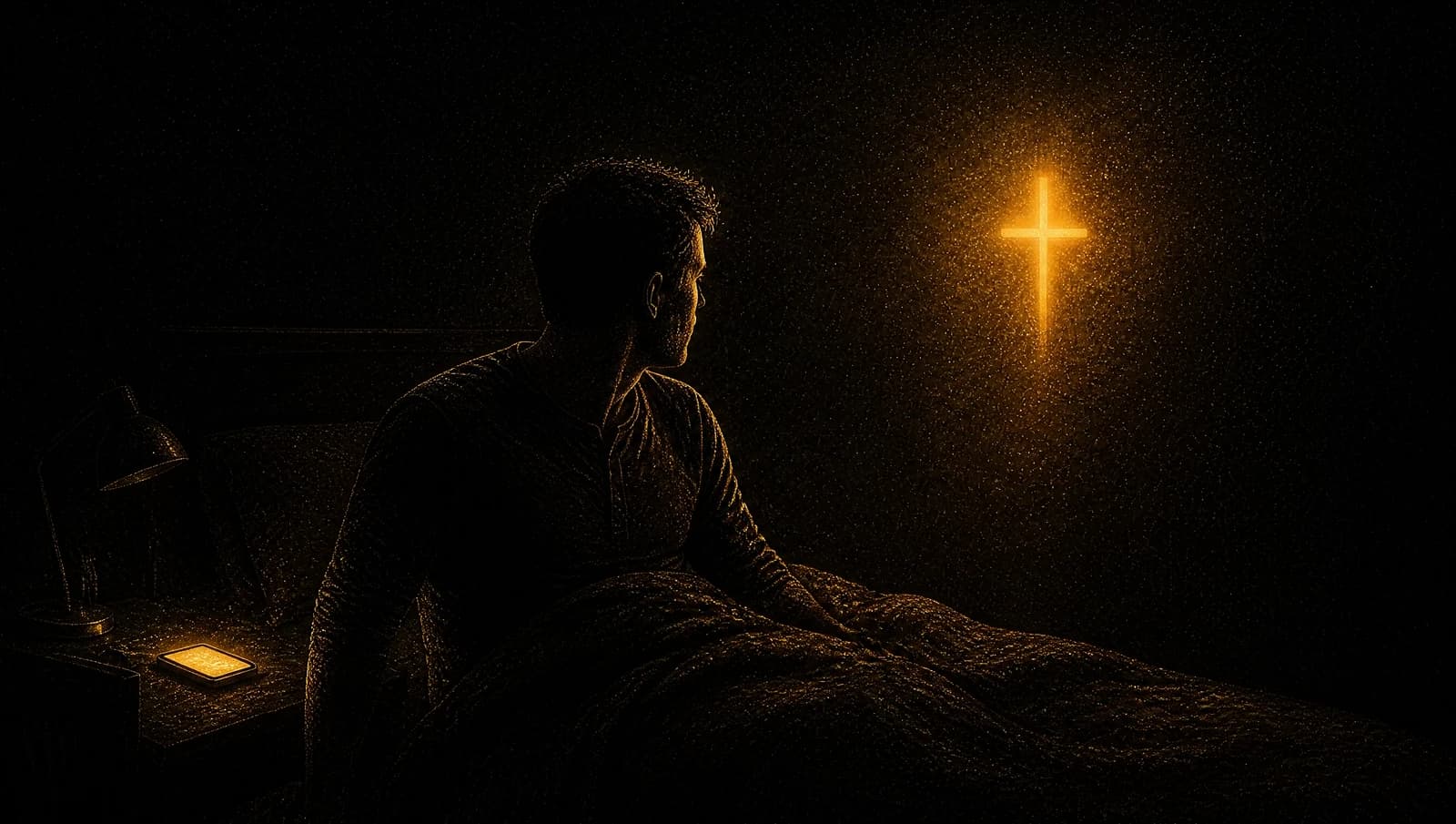
- To interrupt lustful thoughts at night, change your position before you try to change your mind: get out of the bed. Repeatedly using your phone in bed can turn the bed-and-phone routine into a powerful habitual cue, and standing up interrupts it before any willpower is required.
- For many people, nighttime creates a higher-risk setup for lust or porn urges: more privacy, fewer distractions, fatigue, and easy access to a phone.
- One practical first move in bed is to get vertical and turn on a light. Then open PrayBreak and run the Ritual as designed: HOLD, LOOK, PRAY, MOVE.
- A simple wind-down routine (phone charging outside the bedroom, a set lights-out time, one short prayer) can reduce exposure to familiar nighttime triggers before an urge begins.
- If the same struggle keeps happening at night, recurring environmental or emotional triggers may be worth looking at, rather than only trying harder in the moment.
To interrupt lustful thoughts or a porn urge at night: get out of the bed before you start negotiating with yourself. The bed is part of the pattern as much as the phone is, and the first move is a physical one rather than a mental one. Stand up, turn on a light, and run the Ritual: HOLD, LOOK, PRAY, MOVE.
Night is a different battlefield than daytime, and most advice about resisting temptation is written for people standing upright, in the light, with somewhere to be in twenty minutes. None of that is true at 11pm. This article covers why the hours after dark can be harder, a practical way to interrupt an urge while you are already in bed, and how to build a wind-down routine so fewer of these fights start in the first place.
Why do lust and porn urges feel harder to resist at night?
Nighttime tends to remove what makes resisting easier during the day: privacy replaces accountability, the day's tasks are finished, fatigue has set in, and a phone is already within reach. For many people that combination is a higher-risk setup rather than evidence of weaker character than they had at noon.
During the day you are rarely alone, unoccupied, and holding your phone at the same time. Someone might walk in. There is a task in front of you. Night can remove all three guardrails at once: the house is quiet, the day's obligations are finished, and you are horizontal, in the dark, holding the one object that can deliver the fantasy in four seconds.
Night is also, for many people, the first stillness of the day, and stillness is when whatever you outran tends to catch up. For some people, pornography or sexual fantasy can also become a way of responding to loneliness, stress, boredom, or difficult emotions. Research on problematic pornography use has found associations with factors including loneliness and difficulties with emotion regulation, and a systematic review of 66 studies grouped craving, stress, coping styles, and loneliness among the factors linked to it. These are associations, not proof of cause. They do not establish that a particular feeling produces the behaviour. But they are a good reason to ask what else is in the room at 11pm besides the urge.
What should you do when a porn urge hits in bed?
One practical first move is to get out of the bed before you think it through: stand up, and turn on a light. Changing the environment can help interrupt the automatic sequence. Then open PrayBreak and run the Ritual as designed, HOLD, LOOK, PRAY, MOVE, rather than arguing with the urge lying down.
At night, take one practical step before beginning the Ritual: get out of bed. During the day you can often HOLD where you stand. At night the place itself is part of the problem, so get vertical first. That step is not a different version of the Ritual. The Ritual is the same four steps it always is.
Get up
Sit up, then stand. Don't reach for the phone "just to check the time" — that is the negotiation starting. Feet on the floor is the whole first move.
Turn on a light
Darkness is part of what makes the fantasy feel private. Turning on a light changes the environment and can help interrupt the automatic sequence. A phone flashlight pointed at the ceiling counts, as long as it is the ceiling and not the screen.
HOLD — press and hold
Open PrayBreak and press and hold the Break the Urge dial for three seconds while it counts down 3-2-1, with the vibration running the whole time. Letting go early cancels. Completing the hold is what carries you into the rest of the Ritual. This isn't magic; it is a few seconds bought back from autopilot.
LOOK — get your eyes off the fantasy
The app opens one of seven guided grounding exercises. Cross Focus, for example, holds your eyes on a cross with Psalm 46:10, "Be still, and know that I am God," and asks you to breathe slowly. "Different exercise" swaps it for another if that one isn't landing tonight.
PRAY — say the words the app gives you
PrayBreak leads you through a written prayer in five short steps, at your pace, so you don't have to compose anything at 2am. "Different prayer" moves you to another. More battlefield prayers are here if you want one memorised, and there is a bedtime prayer among these prayers against lust and lustful thoughts.
MOVE — change your state
The last step is a guided physical reset, one of eighteen. Cold Reset sends you to the sink for cold water on your face; Step Away has you leave the room and walk for two minutes. Either one gets you out of the bedroom and moving, which is the point.

“Flee from sexual immorality.”
For a Christian, leaving the room is not weakness. Scripture repeatedly uses the language of fleeing sexual temptation rather than standing in it and reasoning it out: Paul tells the Corinthians to flee from sexual immorality, and tells Timothy to flee the evil desires of youth and pursue righteousness alongside other believers. Sometimes the faithful response is not to sit still and negotiate with temptation. It is to move. That conviction is theological rather than clinical, but it points in the same direction the practical advice does, and it is the instinct MOVE was built on.
One wave often isn't the whole night. You might break the urge, drift back toward sleep, and feel it rise again before you are actually out. That is a second wave, not a failed first attempt. Cravings are not necessarily permanent states: research reviewing mindfulness and craving found that craving intensity can change over time and can be experienced without acting on it, which is part of why techniques such as urge surfing are taught that way. That review covered cravings for food, cigarettes, and alcohol rather than pornography, and it cautions that such strategies are not necessarily superior to other approaches, so treat it as a general principle rather than a porn-specific finding. What is and isn't established about how long a porn urge lasts is worth reading on its own. Either way, run the sequence again for each wave. A night with three interrupted waves is a night you won three times, not a night you struggled once.
How do I break the bed-and-phone habit?
Separate the two physically: charge the phone in another room and use a cheap alarm clock instead of your phone's alarm. If the phone is repeatedly part of the nighttime pattern, putting it outside the bedroom creates useful friction before temptation begins, and it is a decision you get to make while rested rather than at 11pm.
You can win the in-the-moment fight every single night and still be exhausted by it, because you keep relitigating the same battle from the same starting position: phone in hand, in bed, in the dark. The higher-leverage move sits upstream of the moment entirely.
- Charge your phone in another room. Not on a nightstand "on silent" — actually outside the bedroom. Charging it elsewhere removes one of the easiest access points and reduces exposure to a familiar cue. There is a side benefit worth naming: in a study of 75 people combining phone-use data with a wearable sleep tracker, smartphone use in bed was associated with worse sleep latency and more time awake, while phone use outside of bed showed no such effect on sleep quality. That is a finding about sleep, not about relapse. But sleep is part of how defended you are the next night.
- Buy a five-dollar alarm clock. The most common reason a phone ends up in bed is "I need it to wake up." Remove the excuse and the phone has no reason to be within reach.
- Set a real lights-out time, not a vague one. "Whenever I get tired" invites scrolling until you are too depleted to make good decisions about anything. A fixed time gives the evening a shape.
- Tell one person the plan. A text to a friend or accountability partner, "phone's charging in the kitchen from now on," turns a private intention into a kept commitment, because someone else now knows to ask.
None of this is about the phone being evil. It is about not fighting from the worst possible starting position: exhausted, alone, in the dark, with the object already in your hand. Removing it is not weakness. It is the same wisdom behind not keeping a bottle in the house of someone trying to stop drinking, and it is the practical shape of what Paul told the Corinthians to do with sexual temptation: flee it, rather than test how long you can stand in front of it.
What does a wind-down routine for nighttime temptation look like?
A wind-down routine starts about thirty minutes before lights-out: the phone goes to a charger outside the bedroom, you say one short prayer or verse out loud, and you do something physically calming instead of scrolling. It can reduce exposure to familiar triggers before an urge begins. The goal isn't a perfect ritual.
Most people only ever fight this battle in the moment, at the worst possible time, with the fewest resources. A wind-down routine moves part of the fight to a calmer hour, when you actually have the clarity to make good decisions.
| Time before bed | Move | Why it helps |
|---|---|---|
| 30 minutes out | Phone goes to its charging spot outside the bedroom | Makes the decision while you are rested, not while you are depleted |
| 20 minutes out | One physical, calming task — shower, stretch, tidy the room | Gives restless energy somewhere to go besides a screen |
| 10 minutes out | One verse or short prayer, said out loud | Trains prayer as the last thing you do before sleep, not the thing you do after a fall |
| Lights out | Same time most nights | A consistent time gives the evening a predictable shape |
“In peace I will lie down and sleep, for you alone, Lord, make me dwell in safety.”
That verse describes a specific kind of night, one where the last thought before sleep is aimed at God rather than at a screen. You are not building a spiritual performance. You are building a closing habit for the day, the same way you would lock a door.
What if this is happening every single night, not just once in a while?
If the same struggle keeps happening at night, recurring environmental or emotional triggers may be worth looking at: an unguarded device, isolation, stress that never gets processed during the day. A nightly pattern is information about the setup, and that usually calls for a change made in daylight, not only a harder effort at 11pm.
Winning one hard night is a battle. Fighting the identical battle every single night is information. It is telling you something about the battlefield itself, not just about your willpower, and that is worth taking seriously rather than gritting through it again tomorrow.
- If sessions are stretching from a quick urge into an hour or more some nights, that's a different pattern worth understanding on its own — here's what gooning is and how it escalates.
- If you're not sure whether what you're fighting counts as an "addiction" or something else, the research on feeling addicted versus being addicted is worth reading before you diagnose yourself in the dark.
- If the nightly pattern has lasted months, a full plan of walls, watchmen, and a weapon — not just an in-the-moment tactic — is laid out in the complete Christian porn recovery guide.
One more thing worth saying plainly: a rough night doesn't erase the nights you won, and it doesn't disqualify you from the fight. If you fall, confess honestly (1 John 1:9), refuse the shame spiral, and return to the fight. "Therefore, there is now no condemnation for those who are in Christ Jesus" (Romans 8:1), and that is as true at 2am as it is on Sunday morning.
Frequently Asked Questions
Why do I only struggle with porn at night?
For many people, night removes the guardrails daytime provides: more privacy, fewer distractions, fatigue, and a phone already within reach. It is also often the first stillness of the day, when stress or loneliness tends to surface. That is a higher-risk setup, not a weaker version of you.
Should I keep my phone in my bedroom at all?
If nighttime urges are a recurring fight, charging it in another room and using a separate alarm clock is worth trying. It removes one of the easiest access points and creates friction before temptation starts. In-bed phone use has also been associated with poorer sleep, which matters the following night.
Is it normal for the urge to come back a second time the same night?
Yes. Breaking one at 11:40 doesn't guarantee immunity at 12:15, so run the same Ritual again. Cravings are not necessarily permanent states, and a night with two interrupted waves is a night you responded twice rather than a night you failed.
What if I already have a phone blocker or accountability app installed?
Good — that's one layer covered. Blockers primarily focus on restricting access, while accountability tools primarily focus on visibility and support. PrayBreak is designed around what to do when temptation is already happening, which is what HOLD, LOOK, PRAY, MOVE is for.
Does praying at night actually help if I'm exhausted and my prayers feel weak?
A one-sentence honest prayer counts fully; length and eloquence aren't the measure. "Jesus, I want this and I don't want to want it. Get me out" prayed in exhaustion is still prayer. God isn't grading effort at 11pm.
- Kheirinejad, Visuri, Ferreira & Hosio — "Leave your smartphone out of bed": quantitative analysis of smartphone use effect on sleep quality (Personal and Ubiquitous Computing, 2023; N=75, app-use data plus wearable sleep tracking). Cited here only for in-bed phone use and sleep, not for pornography outcomes.
- Cardoso, Ramos, Brito & Almeida — Difficulties in Emotion Regulation and Problematic Pornography Use: The Mediating Role of Loneliness (International Journal of Sexual Health, 2023; N=339, cross-sectional self-report). Correlational: it does not establish cause.
- Seyedzadeh Dalooyi, Aghamohammadian Sharbaaf, Abdekhodaei & Ghanaei Chamanabad — Biopsychosocial Determinants of Problematic Pornography Use: A Systematic Review (Addiction & Health, 2023; 66 studies). Factors associated with problematic use, including craving, stress, coping styles, and loneliness.
- Tapper — Mindfulness and craving: effects and mechanisms (Clinical Psychology Review, 2018; review of 30 experimental studies). General craving research on food, cigarettes, and alcohol, not pornography.
Scripture quotations taken from The Holy Bible, New International Version® NIV®. Copyright © 1973, 1978, 1984, 2011 by Biblica, Inc.™ Used by permission. All rights reserved worldwide.
PrayBreak is built for the moment that decides everything — press and hold, then LOOK, PRAY, MOVE. This time, have a weapon in your hand.