
Comparisons
Porn Blocker vs. In-the-Moment Intervention: Which Do You Need?

- Porn blockers and in-the-moment tools serve different purposes. A blocker can reduce easy access by filtering sites, apps, or content. PrayBreak is designed for when temptation is already present.
- Research has found much stronger evidence for psychological treatment of problematic pornography use than for blocking software itself. Neither blockers nor PrayBreak have been shown to be a complete solution.
- PrayBreak now includes optional Shield tools for adding access restrictions. What makes it different from a conventional blocker is the Ritual: HOLD → LOOK → PRAY → MOVE.
- At PrayBreak we organize this as Walls, Watchmen, and a Weapon — access, trusted support, and a practiced response. That is our framework, not a clinically validated model.
- Some people may find one approach useful; others may benefit from combining access restrictions, trusted support, and a plan for the moment temptation appears.
Porn blockers and in-the-moment tools solve different problems. A blocker makes explicit content harder to access; PrayBreak's Ritual gives Christians a structured response when temptation is already happening. Some people may benefit from one, while others may prefer both. The useful question usually isn't "which is better" but "which part of this is currently uncovered for me?"
One disclosure before we start: we make PrayBreak, which sits in the second category. Factor that in as you read. We've tried to write this so a blocker company would find the description of their category fair.
What's the difference between a porn blocker and an in-the-moment response?
A porn blocker uses website filtering, app restrictions, DNS filtering, or device controls to make explicit material harder to access. An in-the-moment response is a practiced sequence you use when temptation is already present. One changes your access; the other changes what you choose to do next.
| Porn blocker / restriction | PrayBreak in-the-moment Ritual | |
|---|---|---|
| Main purpose | Make explicit content harder to access | Give you a structured Christian response when temptation is already happening |
| When it can help | Before or during attempts to access blocked content | When you recognize an urge or temptation |
| What it changes | Access and environment | What you choose to do next |
| Limitation | Restrictions vary by product and may sometimes be changed or bypassed | You have to choose to open and use it |
| Example | Website and app restrictions | HOLD → LOOK → PRAY → MOVE |
The two columns don't really compete. One reshapes your environment, the other gives you something specific to do. The confusion exists mostly because both get marketed under the same broad promise, when they address different parts of the same problem.
Do porn blockers actually work?
Blockers can make explicit material harder to access, which is what they are designed to do. What we do not have is strong research establishing how much adult self-installed blocking software reduces problematic pornography use or relapse over time. Treat a blocker as an access tool rather than a complete solution.
This is where most articles overclaim in one direction or the other, so here is the honest version. Research has found much stronger evidence for psychological treatment of problematic pornography use than for porn-blocking software itself. A blocker clearly changes access conditions. Strong peer-reviewed evidence showing exactly how much self-installed blocking software reduces problematic use or relapse in adults is limited. We are not going to tell you science proves blockers work, and we are not going to tell you science proves they don't.
What can be said fairly: added friction may be useful, especially if easy access is part of someone's pattern. And a practical note rather than a rule — self-managed restrictions may be easier to change or disable than restrictions controlled by someone else, which is why some people choose to involve a trusted person in the setup.
The other limit is about scope rather than strength. A blocker changes access, but it does not necessarily address craving, emotional patterns, or the reasons someone keeps returning to pornography. A systematic review of 66 studies on problematic pornography use lists craving, stress, coping styles and loneliness among the associated factors. Those are associations across groups, not a diagnosis of what is happening with you.
What is an in-the-moment intervention?
At PrayBreak we use "in-the-moment intervention" to describe a practiced response someone uses while temptation is already happening. Ours is HOLD, LOOK, PRAY, MOVE: pause, redirect attention, pray, and take physical or environmental action. It is our framework, not a recognized clinical treatment category.
Most tools in this space are built for calm moments. The blocker runs in the background, the streak tracker gets checked in the morning, the devotional gets read with coffee. At PrayBreak we designed the Ritual for a different moment: when temptation is already present and you would otherwise be improvising. It gives you a sequence to follow instead of an argument to have with yourself.
We want to be careful about what that claim is. The Ritual is a product-design decision, not a tested treatment. It has not been clinically evaluated, it does not treat problematic pornography use, and we are not going to describe it as validated by research that studied something else. Here is the full battle plan if you want to see each step, and the battlefield prayers behind the PRAY step.
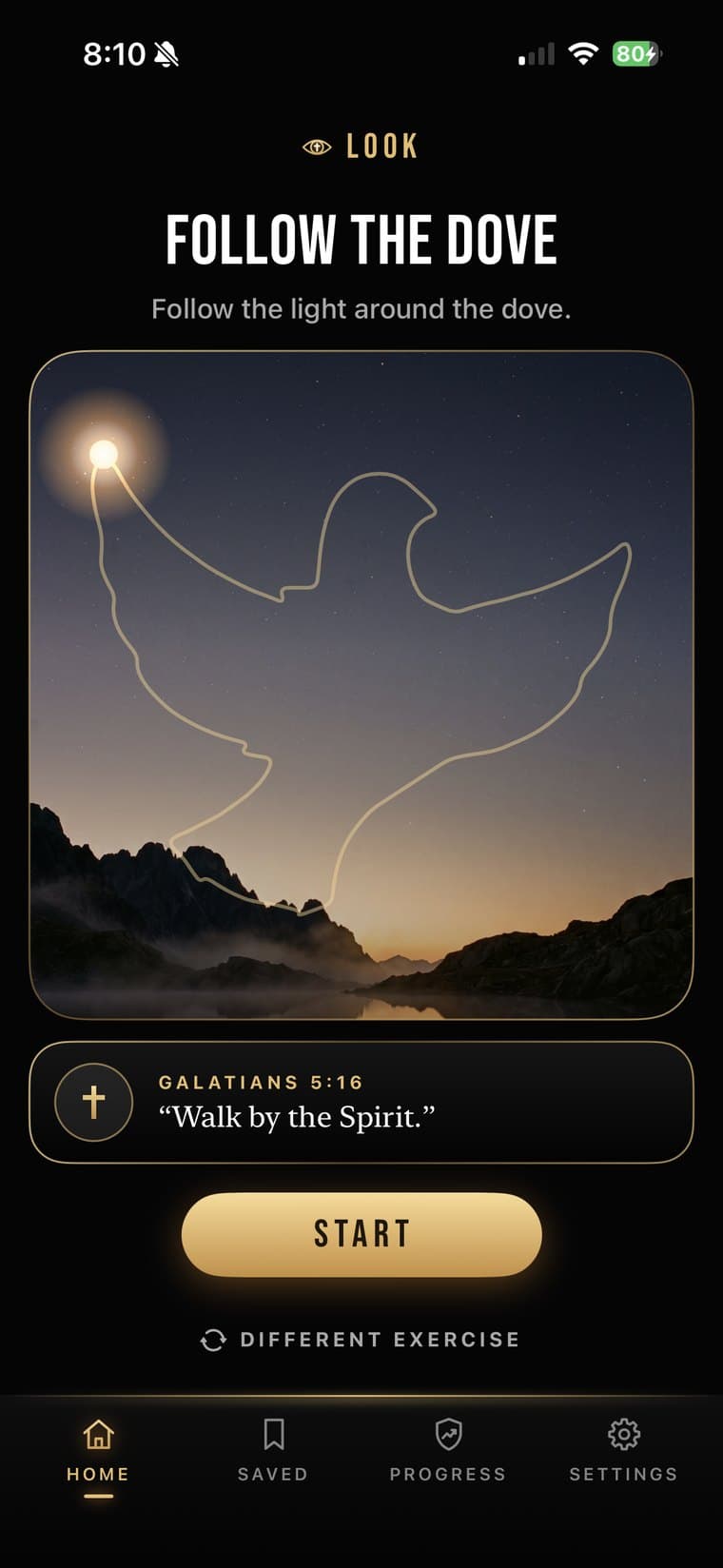
There is a reason researchers are interested in this general area, though it stops well short of endorsing any particular app. A systematic review of 21 experimental studies found differences in attention and inhibitory control among some people with problematic pornography use, while emphasizing the limits of that evidence base. That is part of why interventions addressing craving and cues are being studied at all. It is not evidence for HOLD, LOOK, PRAY, MOVE.
Can a blocker and PrayBreak be used together?
Yes, and PrayBreak itself now includes optional Shield tools for adding access restrictions. Some people may find a layered approach useful: reducing easy access, involving trusted support, and having a plan for the moment temptation appears. A blocker-only setup may be enough for one person and not for another.
Worth correcting something this page used to say: PrayBreak is no longer only an in-the-moment tool. App Shield keeps apps you choose locked until you pray, then opens them for 5, 10, 15 or 20 minutes, and Adult Site Shield walks you through turning on iPhone's own Limit Adult Websites setting, both through Apple's Screen Time system. What still makes PrayBreak different from a conventional blocker is the Ritual, not the absence of blocking.
Start by looking honestly at where your current setup breaks down. These are possibilities to consider rather than a diagnosis:
- Falls that begin with idle scrolling and easy access. Reducing access is the obvious first thing to try: restrictions on the devices you actually use.
- Falls that happen with restrictions already in place. Access may not be the uncovered part. A practiced response for the moment itself may be worth adding.
- Long clean stretches followed by a private stretch nobody knows about. Trusted support may be the missing piece more than either tool (James 5:16).
- Sessions stretching from minutes into hours. That is a distinct pattern worth understanding on its own — here's what gooning is.
Where does accountability fit?
Accountability tools can add another person to the process through reports, alerts, or conversations, depending on the product. Features and timing vary considerably between products. For Christians, James 5:16 gives confession and prayer in community a clear biblical foundation independent of any software.
Accountability products generally work by giving a trusted person some visibility into your device activity. Beyond that, the specifics differ enough between products that a category-level article shouldn't make evergreen claims about any one of them. If you're comparing options, our honest comparison of the current apps goes product by product.
Scripture teaches the underlying principle without needing software to carry it. "Confess your sins to each other and pray for each other so that you may be healed" (James 5:16). A trusted friend, a pastor, or an accountability partner can do the work an app is trying to approximate, and the relationship is what any tool depends on.
Scripture also speaks to practical safeguards. Matthew 5:29 illustrates the seriousness with which Jesus calls people to deal with what repeatedly leads them toward sin; for some Christians, putting practical restrictions around pornography access is one modern application of that principle. Paul's instruction to "make no provision for the flesh" (Romans 13:14) points the same way. Neither verse is evidence that filtering software works — they establish the principle, not the product.
And when temptation is already present, Scripture's own instruction is to leave: "Flee from sexual immorality" (1 Corinthians 6:18), and flee the evil desires of youth while pursuing righteousness. 1 Corinthians 10:13 reminds Christians that temptation is not irresistible and that God is faithful in the midst of it. PrayBreak is one practical tool a person may choose to use in that moment; it is not the way of escape that verse describes. The wider plan is in the Christian porn recovery guide.
Frequently Asked Questions
Do porn blockers actually work?
Porn blockers can make explicit material harder to access, which is exactly what they are designed to do. What we do not currently have is strong research establishing how much adult self-installed blocking software reduces problematic pornography use or relapse over time. Think of a blocker as an access tool rather than a complete treatment.
Can't I just use a blocker and skip everything else?
You can. For some people, reducing access may be very helpful. Others may find they also need trusted support or a plan for what to do when temptation is already present. It depends on where your current setup actually breaks down.
What's the best porn blocker for Christians?
Look for restrictions that cover the devices and apps you actually use and, if appropriate, allow a trusted person to help manage settings. The right setup depends on your devices and needs. Our comparison of the current apps goes through the options.
Is using a porn blocker unspiritual — shouldn't prayer be enough?
No. Christians have long used practical boundaries to avoid temptation. Matthew 5:29 and Romans 13:14 both point toward dealing seriously and practically with what leads you toward sin. Prayer and practical safeguards do not have to compete.
What should I do if temptation gets past my blocker?
Stop engaging with the content, put distance between yourself and the trigger, pray, and use whatever practiced response you have chosen. PrayBreak's version is HOLD → LOOK → PRAY → MOVE. Scripture's own instruction for sexual temptation is to leave (1 Corinthians 6:18).
What is PrayBreak, and how is it different from a blocker?
PrayBreak is a Christian app designed for moments of lust and pornography temptation. It includes optional Shield tools for adding access restrictions, but its core Ritual — HOLD, LOOK, PRAY, MOVE — is what differentiates it: a structured response for when temptation is already happening.
- López-Pinar, Esparza-Reig & Bőthe — Psychotherapy for problematic pornography use: A comprehensive meta-analysis (Journal of Behavioral Addictions, 2025; 20 studies, 2,021 participants). Concerns psychological treatment, not blocking software. Authors note a high risk of bias across included studies.
- Zwielewski et al. — Cognitive behavioral therapy-based interventions for problematic pornography use: a scoping review (Sexual Medicine Reviews, 2026; 11 studies). Finds no widely accepted standardized evidence-based treatment protocol for PPU.
- Castro-Calvo, Cervigón-Carrasco, Ballester-Arnal & Giménez-García — Cognitive processes related to problematic pornography use: A systematic review of experimental studies (Addictive Behaviors Reports, 2021; 21 studies). Authors note the experimental evidence base is still limited.
- Baumeister, Gehlenborg, Schuurmans & Moritz — Reducing problematic pornography use with imaginal retraining: a randomized controlled trial (Journal of Behavioral Addictions, 2024; N=274). Per-protocol analysis showed a reduction; intention-to-treat did not corroborate it, and adherence was low. Included to show low-threshold self-help is being studied, with mixed results.
- Seyedzadeh Dalooyi et al. — Biopsychosocial Determinants of Problematic Pornography Use: A Systematic Review (Addiction & Health, 2023; 66 studies). Factors associated with problematic use, not established causes.
Scripture quotations taken from The Holy Bible, New International Version® NIV®. Copyright © 1973, 1978, 1984, 2011 by Biblica, Inc.™ Used by permission. All rights reserved worldwide.
PrayBreak is built for the moment that decides everything — press and hold, then LOOK, PRAY, MOVE. This time, have a weapon in your hand.