
Scripture & Prayer
What to Pray When You're Tempted: 10 Battlefield Prayers for the Moment of Temptation
- When temptation hits, you don't need an eloquent prayer. A short, honest prayer brings the moment directly before God while you take practical steps away from what is pulling at you.
- Scripture teaches prayer in temptation, not only after it: "Watch and pray so that you will not fall into temptation" (Matthew 26:41).
- You do not have to make yourself worthy first. Hebrews 4:16 invites believers to approach the throne of grace for "grace to help us in our time of need."
- Prayer and obedience belong together. Scripture repeatedly says to flee sexual immorality (1 Corinthians 6:18; 2 Timothy 2:22), and Genesis 39:12 describes Joseph leaving the room.
- Below are ten short prayers to keep ready so you are not composing words under pressure. Pick two or three and make them familiar.
When sexual temptation hits, you do not need an elaborate prayer. Tell God honestly that you are tempted, ask for grace to obey, and take a practical step away from what is drawing you toward sin. Matthew 26:41 calls Christians to "watch and pray" in temptation, and Hebrews 4:16 invites believers to seek grace in their time of need.
Some Christians find themselves praying about lust in the morning and praying again after a fall, but going quiet during the temptation itself, when it feels wrong to say His name with the tab already open. This article gives you ten short prayers for that exact moment, the Scripture behind each one, and why praying during temptation is worth doing. For longer prayers against lust itself, for your thoughts, your eyes and bedtime, see prayers against lust and lustful thoughts.
Why pray during temptation instead of after?
Scripture teaches it plainly. Jesus said, "Watch and pray so that you will not fall into temptation" (Matthew 26:41), and Hebrews 4:16 invites Christians to approach God for "grace to help us in our time of need." Prayer after a fall is confession. Prayer during the fight is asking for help while you still need it.
“Watch and pray so that you will not fall into temptation. The spirit is willing, but the flesh is weak.”
Scripture teaches that prayer belongs inside the moment of temptation, not only after it. Jesus said this in Gethsemane, to disciples who were about to fail Him, in the hardest hour of His life. He was not speaking about sexual temptation specifically; it is a general teaching about temptation, and it applies here as naturally as anywhere.
There is a practical reason too, and it is worth stating plainly rather than dressing it up as something it isn't. At PrayBreak we think of it this way: prayer gives you something faithful to do instead of continuing to entertain or negotiate with the temptation. It does not guarantee the temptation immediately disappears. It changes what you are choosing to do in the middle of it.
“For we do not have a high priest who is unable to empathize with our weaknesses, but we have one who has been tempted in every way, just as we are — yet he did not sin. Let us then approach God's throne of grace with confidence, so that we may receive mercy and find grace to help us in our time of need.”
Scripture teaches that Christ was tempted yet without sin, and that believers may therefore approach God confidently for mercy and grace in their time of need. You do not have to make yourself worthy before calling on God. That is the whole force of "with confidence" in verse 16, and it is the answer to the quiet conviction that God's line is closed to you right now.
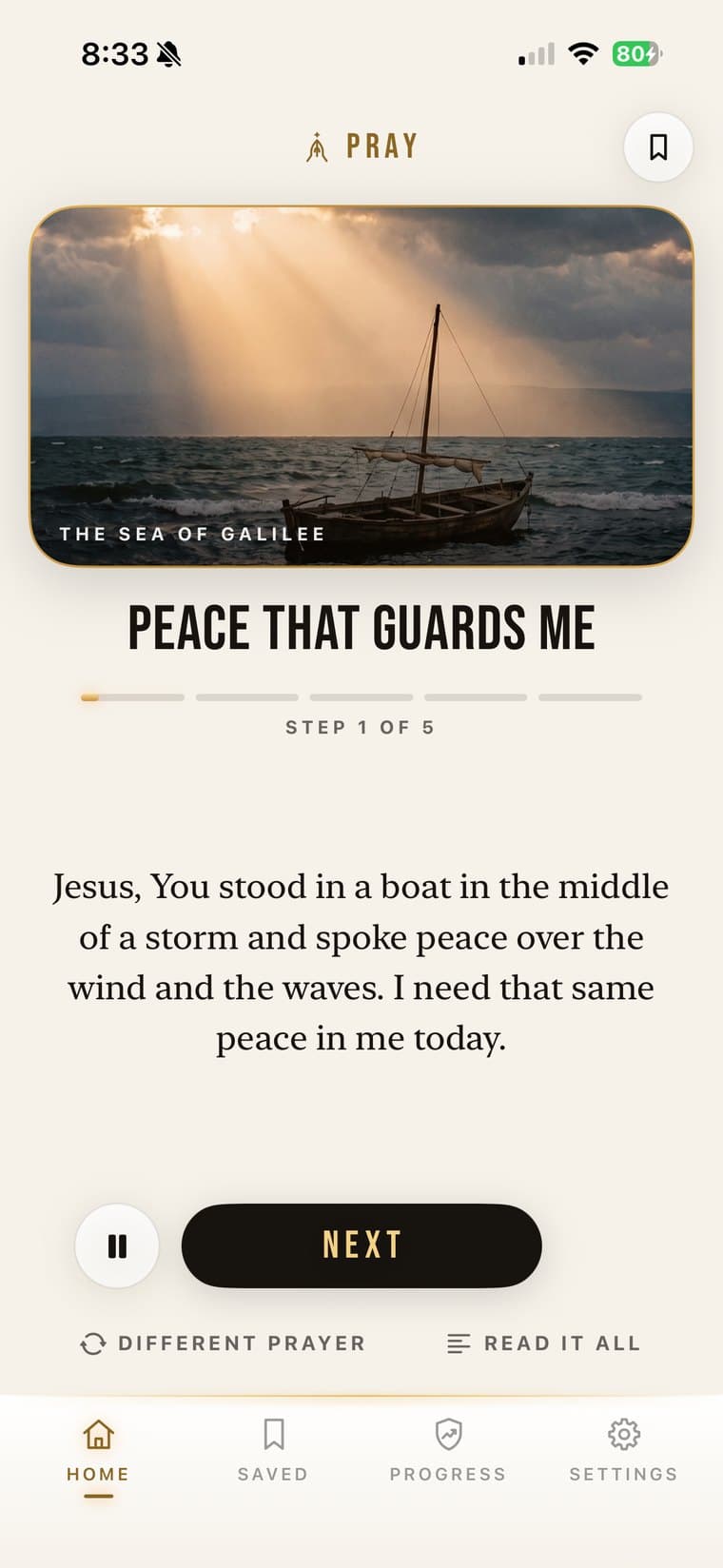
What are the 10 battlefield prayers?
Ten short prayers, each matched to a moment: the first sign of temptation, the negotiation, what may be underneath it, the almost-fall, and the aftermath. At PrayBreak we keep them short on purpose. Pick two or three and make them familiar, because you will not compose anything under pressure.
Don't try to use all ten. Pick the two or three that sound like your own voice and make them familiar, so you are not searching for words at the hardest moment. Much of the Psalms is exactly this: words given to God's people for moments when their own had run out.
The first-second prayer
"Jesus. Here. Now." When you recognize temptation, you can pray immediately rather than waiting for the situation to escalate. "God is our refuge and strength, an ever-present help in trouble" (Psalm 46:1).
The honest prayer
"Jesus, I want this and I don't want to want it. Get me out." One honest example, not a formula. God already knows what is in your heart; prayer does not require pretending the temptation is absent. "Pour out your hearts to him" (Psalm 62:8).
The grace-and-escape prayer
"Jesus, I'm tempted right now. Give me grace to obey, help me take the way out, and turn me away from what is pulling me toward sin." This draws on 1 Corinthians 10:13, where God is faithful and provides a way out. Ask for help recognizing and taking that way, then act on Scripture's own instruction to flee sexual immorality (1 Corinthians 6:18).
The weakness prayer
"I have no strength for this tonight. Be strong for me." For the nights when you're exhausted and the fight feels lost already. "My grace is sufficient for you, for my power is made perfect in weakness" (2 Corinthians 12:9). Admitting the emptiness is the prayer.
The searching prayer
"Lord, I'm tempted. Search me and show me what else may be going on in my heart — loneliness, stress, anger, boredom, or something else." "Search me, God, and know my heart" (Psalm 139:23–24). Sometimes the honest answer is simply that you are tempted, and that is worth praying too.
The eyes prayer
"Turn my eyes away from worthless things; preserve my life according to your word." One especially relevant prayer is Psalm 119:37, which you can pray in Scripture's own words on the nights your own feel used up.
The negotiation prayer
"I'm done debating. You decide, and I'll obey." For the moment you catch yourself bargaining ("just for a minute… just this once"). Philippians 4:8 gives the redirection: whatever is true, noble, right, pure, think on those things.
The fleeing prayer
"Give me grace to walk out of this room." Prayed while you physically leave. When Joseph was confronted with sexual temptation, Genesis 39:12 describes him leaving his cloak and running out of the house. The text does not say he prayed; it says he left. A prayer can accompany that action.
The after-the-win prayer
"That was You. Thank You." If temptation passes without you acting on it, thank God for His help. "Thus far the Lord has helped us" (1 Samuel 7:12) is a picture of remembering what God has already done.
The after-the-fall prayer
"I fell. I'm not hiding. Wash me and put me back in the fight." If you sin, you do not need to wait before confessing. "If we confess our sins, he is faithful and just and will forgive us our sins" (1 John 1:9), and Psalm 51:10 gives the words: "Create in me a pure heart, O God."
One note on the searching prayer, because it is easy to overstate. Research has found that problematic pornography use is associated with factors including loneliness and difficulties with emotion regulation, and a systematic review of 66 studies lists craving, stress, coping styles and loneliness among the factors linked to it. Those are associations across groups of people, not a rule about your particular temptation. Sometimes what is happening is exactly what it looks like. The prayer asks God to show you; it does not decide the answer in advance.
Can I pray when I'm already giving in to temptation?
Yes. Call on God immediately, and let the prayer move you toward repentance and away from the behaviour. You do not need to make yourself spiritually presentable before asking for mercy, but prayer should not become permission to remain willingly in the sinful situation.
This is one common reason Christians stay silent mid-fight: a quiet conviction that God's line is closed right now. After I close the tab. After a clean week. After I feel sorry enough. It sounds humble, and it keeps people from praying at exactly the moments they most need to.
“Out of the depths I cry to you, Lord; Lord, hear my voice. Let your ears be attentive to my cry for mercy.”
"Out of the depths." Not from the mountaintop, not from the morning quiet time. The Psalms model prayer from inside the wreckage. Jesus' own parable contrasts a confident man's prayer with a tax collector's seven words, "God, have mercy on me, a sinner," and says the second man went home justified (Luke 18:13–14). You do not need to stay silent. Scripture repeatedly invites people to cry out to God for mercy and help.
What Bible verses help with sexual temptation?
Five worth knowing well: Matthew 26:41 (watch and pray), 1 Corinthians 10:13 (God's faithfulness and a way out), Psalm 119:37 (turn my eyes), Hebrews 4:15–16 (grace in the time of need), and 1 Corinthians 6:18 (flee sexual immorality). Having a few already familiar makes them easier to recall.
| Verse | The line | When it fits |
|---|---|---|
| Matthew 26:41 | "Watch and pray so that you will not fall into temptation." | The moment you first recognize what is happening |
| 1 Corinthians 10:13 | "He will also provide a way out so that you can endure it." | When it feels like there is no exit from the moment |
| Psalm 119:37 | "Turn my eyes away from worthless things." | The first glance, the scroll, the almost-click |
| Hebrews 4:15–16 | "Grace to help us in our time of need." | When shame says God doesn't want to hear from you right now |
| 1 Corinthians 6:18 | "Flee from sexual immorality." | When the faithful next move is simply to leave |
Having a few relevant passages already familiar can make them easier to recall when temptation hits. Matthew 4:1–11 records Jesus answering each temptation in the wilderness with Scripture. The passage does not describe a memorization technique and is not offered here as one; it simply shows Scripture being used in the moment of temptation. Quotations throughout this article are NIV.
Two more worth having for the aftermath rather than the moment: 1 John 1:9 on confession and forgiveness, and Romans 8:1, "there is now no condemnation for those who are in Christ Jesus." Romans 8:1 speaks to condemnation, not to whether the sin mattered. Hold both.
How do I make praying in the moment more natural?
Pick one or two short prayers and rehearse them occasionally, so they are easier to remember under pressure. At PrayBreak we pair the prayer with the HOLD step so the two become one move. That is familiarity, not a technique that installs itself on a schedule.
The reframe worth keeping: you cannot stop temptation from arriving, so let its arrival be a prompt to pray. The signal that used to start something else can start the prayer instead.
- Pick one prayer and make it familiar. Say your chosen prayer a few times when you are calm, so the words are already there when you are not.
- Pray out loud if it helps and you are somewhere appropriate. Some people find it easier to stay focused that way. A whisper is fine, and silent prayer is still prayer.
- Anchor it to the HOLD step. If you use the 4-step battle plan, the hold is the cue: hold first, then pray.
- Take a practical step with it. Put the phone down, close the screen, move to another room, go somewhere other people are, take a short walk somewhere safe, or contact someone you trust. If the fight is mostly a nighttime one, the nighttime playbook is here.
Paul told the Thessalonians to "pray continually" (1 Thessalonians 5:17). The verse describes a life characterized by ongoing prayer, which certainly leaves room for turning to God the moment temptation appears. Prayer is one layer of a larger fight, and the full Christian porn recovery guide shows where it fits alongside the rest.
Frequently Asked Questions
What is the best short prayer for sexual temptation?
There is no required formula. One simple option: "Jesus, I'm tempted right now. Give me grace to obey and help me take the way out." Others prefer "Jesus. Here. Now." or Psalm 119:37 in Scripture's own words. What matters is honest dependence on God, not perfect wording.
Does God hear prayers prayed during temptation, even if part of me wants to sin?
Yes. Divided desire is the ordinary condition of anyone resisting temptation. Psalm 130 models crying out "from the depths," and Hebrews 4:15–16 says Christ was tempted yet without sin and invites believers to approach God confidently for mercy and grace in their time of need.
Should I pray long prayers to fight lust?
Prayer does not need to be long. If a short prayer helps you act quickly and move away from the temptation, use one. Longer prayer can also be appropriate. Scripture sets no rule against praying at length in the middle of temptation.
What Bible verse should I say when tempted to watch porn?
Psalm 119:37 fits especially well: "Turn my eyes away from worthless things; preserve my life according to your word." It is a prayer and a verse in one sentence. Pair it with 1 Corinthians 10:13 and then take a practical step away from the temptation.
I prayed and the urge didn't go away. Did prayer fail?
No. Scripture does not promise that every temptation disappears immediately when you pray. Prayer is not an off switch for sexual desire or craving. Keep seeking God, pray again if you need to, and take practical steps away from the temptation.
Should I pray after I relapse, or wait until I feel genuinely sorry?
Pray now. You do not need to wait until you feel sufficiently ashamed or worthy. Confess honestly and turn back toward God: 1 John 1:9 puts no waiting period on confession, and Psalm 51 gives words for repentance after sexual sin.
- Scripture referenced (NIV): Matthew 26:41; Hebrews 4:15–16; 1 Corinthians 10:13; 1 Corinthians 6:18; 2 Timothy 2:22; Psalm 119:37; Psalm 62:8; Psalm 139:23–24; Psalm 130:1–2; Psalm 51:10; 1 John 1:9; Romans 8:1; Genesis 39:12; Matthew 4:1–11; Luke 18:13–14; 1 Samuel 7:12; 1 Thessalonians 5:17; Philippians 4:8; 2 Corinthians 12:9; Psalm 46:1
- Research — Cardoso, Ramos, Brito & Almeida: Difficulties in Emotion Regulation and Problematic Pornography Use: The Mediating Role of Loneliness (International Journal of Sexual Health, 2023; N=339, cross-sectional self-report). Correlational; it does not establish cause, and it did not study prayer.
- Research — Seyedzadeh Dalooyi et al.: Biopsychosocial Determinants of Problematic Pornography Use: A Systematic Review (Addiction & Health, 2023; 66 studies). Factors associated with problematic use, not established causes, and not a study of prayer.
Scripture quotations taken from The Holy Bible, New International Version® NIV®. Copyright © 1973, 1978, 1984, 2011 by Biblica, Inc.™ Used by permission. All rights reserved worldwide.
PrayBreak is built for the moment that decides everything — press and hold, then LOOK, PRAY, MOVE. This time, have a weapon in your hand.